In January 2019, the father of teenager Molly Russell claimed distressing images found on social media sites including Instagram “helped kill my daughter”. His statement caused an increase in calls from concerned parents to youth mental health charities and an apology from Facebook, the owners of Instagram.
Young people’s suicide charity Papyrus told the BBC that within a week of Molly’s death being reported, they had around 30 calls from parents who believed social media played a part in their children’s suicides. It also resulted in a warning from Health Secretary Matt Hancock that if social media firms do not heed calls to remove harmful content, Parliament has the power to ban them. Speaking on the Andrew Marr show, he said if social media companies “need to do things they are refusing to do, then we can and must legislate.” He stated that the government must act to ensure “this amazing technology is used for good, not leading to young girls taking their own lives.”

- Photo by rawpixel.com on Pexels.com
More recently in 2017, the NHS undertook a survey on the mental health of 9,117 children and young people aged 2 to 19, between January and October 2017. It revealed that 1 out of 8 5-19 year olds had a mental disorder – emotional, behavioural, hyperactive or otherwise. Emotional disorders particularly increased when the children became teenagers and appeared to be more of an issue for girls than boys. Between the ages of 5-10 the two main emotional disorders, depression and anxiety, were higher for boys compared to girls. However, from the age of 11-19, there is a significant increase in the amount of girls with an anxiety disorder – roughly four times the number of girls at age 5-10.
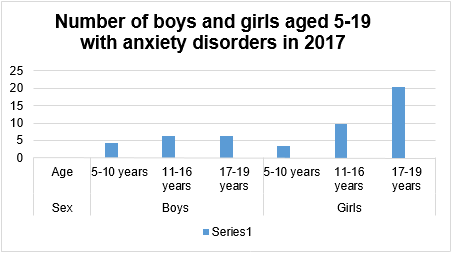
Graph: Frances Butler
On the other hand, although less young people overall had depressive disorders, it affected both boys and girls. Whilst there were still a significantly higher number of girls than boys, the highest number for both was between the ages of 17-19.
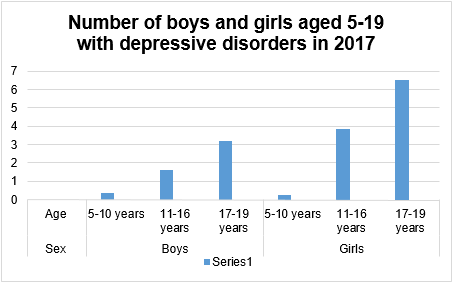
Graph: Frances Butler
Whilst the number of children with emotional disorders is small when compared to the 9,117 children that took part – less than 7 girls with depressive disorders and just over 20 with anxiety disorders – the research shows that mental health is serious problem for some children, and becomes more frequent in their teenage years – so why isn’t it being picked up on? One possible reason is that mental health issues are more commonly associated with adults rather than children.
A study published in The Lancet Psychiatry in February found that out of more than 2,000 18 year-olds, nearly a third had experienced childhood trauma; a quarter of which went on to develop Post Traumatic Stress Disorder (or PTSD), which can cause the person to feel isolated and experience flashbacks and disassociation. As told to the BBC, 20 year-old Flo Sharman had a breakdown when she was 8, linked to the trauma of an operation where she had to be resuscitated multiple times as a baby. Doctors believe her breakdown was caused by PTSD. She says her parents had no idea it could have been caused by the operation, and many people don’t associate PTSD with a young child – it’s more often linked to those in the armed forces.
Another potential reason is the circumstances the child is in, and what they may be experiencing. A study published by University College London in January revealed children who experience a family break-up as an older child or young teenager are more likely to develop emotional and behavioural problems than those living with both their parents. Co-author of the study Emla Fitzsimons said family splits in late childhood are “detrimental to adolescent mental health”, possibly because children are “more sensitive to relationship dynamics at this age”, and family break-ups may be more disruptive to the child’s education and peer relationships.

- Photo: Pixabay on Pexels.com
What is being done to tackle the issues many children and young people seem to be facing?
One example is Children’s Mental Health Week, which took place in February this year. Launched by Place2Be in 2015, it aims to highlight the importance of children and young people’s mental health through resources for schools, youth groups and parents and carers. A registered charity, it relies on donations and its supporters include the Duke and Duchess of Cambridge, both founding members of the Heads Together campaign which aims to tackle the stigma surrounding mental health.
Mental health charity Mind also addresses some of the issues children and young people face, offering a list of organisations that provide support for them – such as Young Minds and Childline – as well as a guide for parents who may be struggling with their own mental health.
You can find out more about the organisations mentioned in this article by following these links:
Papyrus: https://papyrus-uk.org/ or call 0800 068 4141
Children’s Mental Health Week: https://www.childrensmentalhealthweek.org.uk/
Heads Together: https://www.headstogether.org.uk/
Mind: https://www.mind.org.uk/
Young Minds: https://youngminds.org.uk/
Childline: https://www.childline.org.uk/ or call 0800 1111
Frances Butler
 Frances' News in Norwich