
It’s a novel which draws inspiration from J.R.R. Tolkien’s The Lord of the Rings, “truly defies all efforts of categorization” and has been labelled a “colonial-era catalogue of clichés” by The Guardian – but tonight Marlon James is here to talk about Black Leopard, Red Wolf in his own words.
UEA alumni and crime writer Tom Benn opens the conversation by asking James about some of his previous work. It turns out the author was already researching the new novel before winning the Man Booker Prize for A Brief History of Seven Killings – about the attempted assassination of Bob Marley – in 2015. As the first book of a fantasy trilogy that James has described as an “African Game of Thrones”, you might expect it to be meticulously planned out – but James says this isn’t the case.
“Once you start thinking about what you should write, then you’re in trouble.”
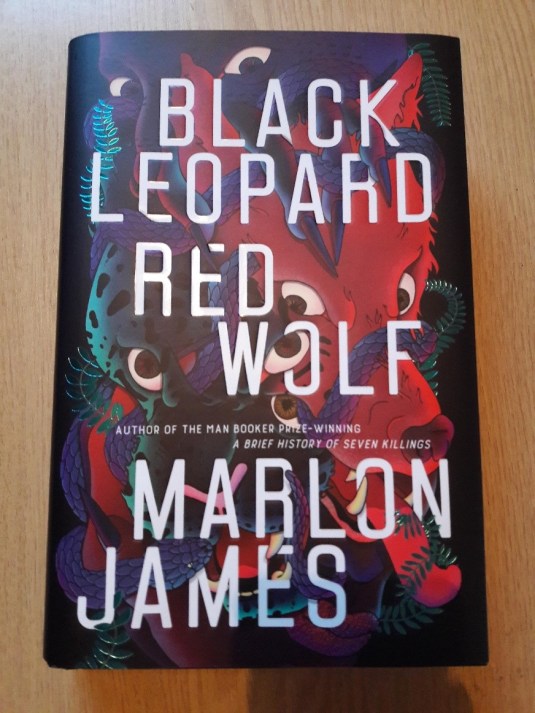
A hardcover copy of Black Leopard, Red Wolf.
Photo: Frances Butler
Drawing on a rich history of African mythology, the novel avoids a common fantasy trope found most notably in George R.R Martin’s A Song of Ice and Fire series: starting with the rise or fall of a royal house. As James tells Benn, when writing his characters, he wanted to start at the bottom rather than the top.
“I started at the street and didn’t really care about whether they got to the royal house.”
He wanted to have a character who could explore the dirty, dangerous aspects of the world from ground level, which lead to the creation of the protagonist, Tracker. However, they do eventually get to the royal house. The passage James chooses to read aloud details the moment a queen meets the first light-skinned man she has ever seen. ‘Sandman’, as she calls him, has to have his words translated by Tracker and is stripped in front of the court, who are directed to laugh or gasp when deemed appropriate. Heavily inspired by Lewis Carroll’s Queen of Hearts, it shows how James’ writing manages to inject humour and wit into a situation with just enough dark, political undertones to make you uncomfortable. It could be seen as a comment on colonialism, racism or class: and James insists we have to remember those who have suffered – or are suffering – in order for progress to be made.
“Who’s lifting up that tower that you’re stepping on?”
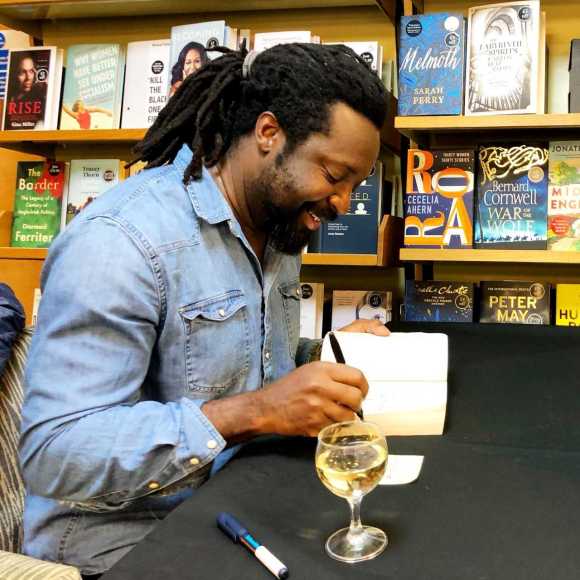
Marlon James signs copies of his books at UEA Waterstones after the talk.
Photo: @UEALitFest
In a fantasy world described by Benn as a unique example of a “black, queer, sword and sorcery” narrative, James tackles the prominent issue of representation. Whilst unsure whether it can be labelled as an African novel, he believes “it’s the only context in which this book can exist.” African tales are not typically male-centric, and Tracker’s role as an unreliable narrator is similar to folklore tricksters such as Anansie the Spider. James points out to the audience that you don’t always have to write from personal experience, as he has heard people say they can’t write black people, as they don’t have any black friends. His response? “I don’t know any serial killing maniacs, but I’ve written one.”
As the talk draws to a close, Benn asks James if any of the criticism towards Black Leopard, Red Wolf bothers him. Quite the opposite, in fact. Referring a to a particular comment made by The Guardian, he exclaims:
“Oh my goodness, I’m Heart of Darkness for gamers?! Can I get a t-shirt?”
Frances Butler
 Frances' News in Norwich